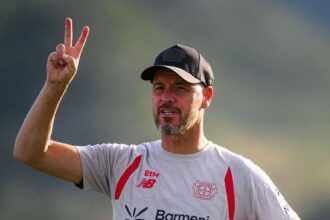

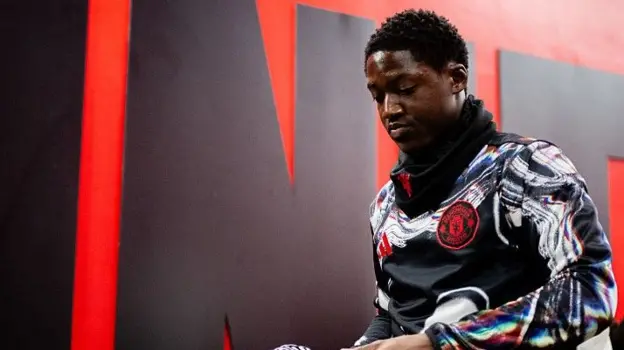


Manchester United head coach Ruben Amorim has doubled down on his decision-making regarding the club’s academy players, insisting his priority is winning matches rather than preserving reputations or responding to public pressure. His comments come amid growing scrutiny over the lack of first-team minutes for homegrown midfielder Kobbie Mainoo and other youth prospects this season.
United’s tradition of including at least one academy graduate in every matchday squad since 1937 remains intact, but critics argue the spirit of that record is being stretched. While academy players have occupied places on the bench, their involvement on the pitch has been minimal. Mainoo, widely regarded as United’s brightest young talent, has played only 171 minutes in the Premier League across nine substitute appearances. He has not started a league match this season.
Amorim again defended his approach on Friday, emphasising that performances, not sentiment, determine selection.
“I just want to win. I don’t look at who it is. I don’t care about that. I’m just trying to put the best players on the pitch,” he said.
The 20-year-old Mainoo has struggled for minutes despite his remarkable rise in 2024, during which he scored in the FA Cup final and started for England in the Euro 2024 final. But Amorim views him as a direct competitor to captain Bruno Fernandes, a role where opportunities are limited. Since Fernandes sustained an injury in October, United have yet to find a consistent replacement, with Amorim opting for experience over youth in crucial midfield positions.
Mainoo, who was strongly linked with Napoli on loan during the summer window, remains open to leaving the club temporarily to ensure regular football ahead of the 2026 World Cup cycle. United rejected the loan proposal, believing he would contribute under Amorim’s leadership. But his continued lack of involvement has raised questions internally and externally about his development pathway.
United’s academy pipeline remains active behind the scenes. The club recently hired Stephen Torpey from Brentford to lead their youth development, signalling a commitment to long-term talent growth. Promising 15-year-old forward JJ Gabriel was pictured in the directors’ box during United’s 1-1 draw with West Ham this week, further highlighting the club’s investment in future prospects.
However, game time tells a different story. Local defender Tyler Fredricson has not played a single minute since starting in the EFL Cup defeat to Grimsby in August. Jack Fletcher briefly made the bench during Mainoo’s injury absence, and England Under-20 winger Shea Lacey has been an unused substitute in three consecutive fixtures. Even when United lacked attacking options due to injuries, Amorim refrained from introducing Lacey, prompting concerns that he does not fully trust the academy’s output.
When challenged on this perception, Amorim pushed back. “Any players? We have Kobbie Mainoo…” he responded pointedly, before defending his reluctance to use Lacey. “Why would I put Lacey on when there are internationals on the bench? I try to put on the best guys, the prepared guys, for this moment of the club.”
Amorim admitted he is frustrated by the constant questioning surrounding Mainoo, but acknowledged the attention is understandable: “You love Kobbie. He starts for England. But that doesn’t mean I need to put him in when I feel I shouldn’t. It’s my decision.”
With Bryan Mbeumo and Amad Diallo set to leave for Africa Cup of Nations duty later this month, opportunities could open for Mainoo or Lacey. But Amorim refused to guarantee anything. “I don’t know what is going to happen,” he said. “It depends on training and what is best for the team.”
United’s struggles this season — including dropped points in key fixtures and a failure to break into the top five — have intensified scrutiny on the head coach’s every decision. The tension between maintaining the club’s youth identity and chasing immediate results remains one of the defining challenges of Amorim’s tenure.
For now, he remains steadfast: development is a priority, but only when it aligns with winning. Whether that balance can satisfy both club tradition and competitive ambition is a question Manchester United are still trying to answer.
Read Also: Amorim admits team defeat to Everton at Old Trafford