

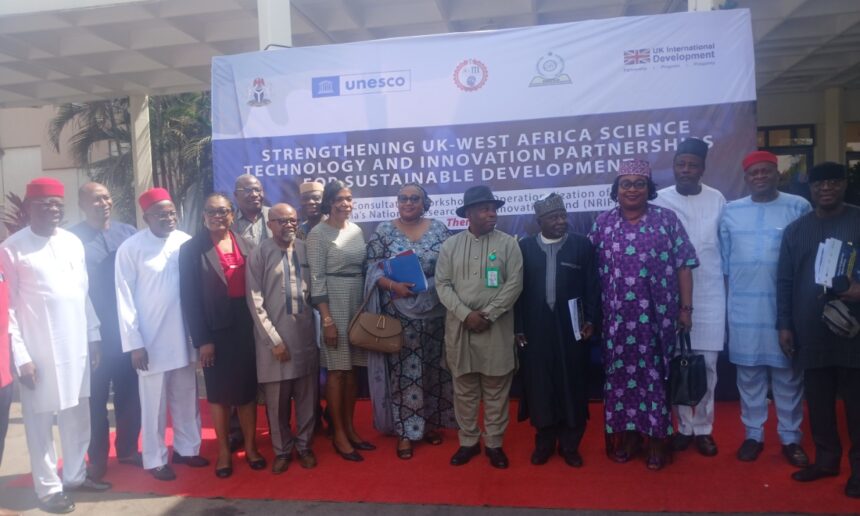

The United Nations Educational, Scientific and Cultural Organisation, UNESCO, has urged key stakeholders, including the Nigerian Government, to fast-track the implementation and operationalisation of Nigeria’s National Research and Innovation Fund, NRIF.
The call was made on Monday at a three-day consultation workshop—the first of its kind in Nigeria—focused on operationalising the NRIF.
The fund is to be implemented under a project titled “Strengthening UK–West Africa Science, Technology and Innovation Partnerships for Sustainable Development,” also known as the Sankore Project.
Named after a historic centre of learning in West Africa, the Sankore Project is a new accountable grant mechanism supported by the UK Foreign, Commonwealth and Development Office, FCDO. It is being delivered through two workstreams aimed at strengthening Science, Technology and Innovation, STI systems in Nigeria and Ghana, implemented by UNESCO and Results for Development, R4D.
Dr Enang Moma, National Professional Officer, Natural Science Sector, UNESCO Abuja, said the project is designed to drive transformative change by strengthening STI ecosystems in both countries.
According to her, the initiative will improve data accessibility, promote open science, and advance the commercialisation of research, enabling communities to harness innovation for sustainable development and social progress.
She listed agencies involved in implementing the project to include the Sheda Science and Technology Complex, SHESTCO, the National Office for Technology Acquisition and Promotion, NOTAP, and the National Biotechnology Development Agency, NABDA, among others.
Ms Kornelia Tzinova, Head of the Natural Science Sector at UNESCO’s Regional Office in Dakar, Senegal, stressed that the success of the project depends on sustained political support and strong leadership from participating agencies.
She emphasised the need to align the initiative with national development frameworks to maximise its impact on Nigerians. Tzinova noted that Ghana had made significant progress in operationalising its National Research Fund, adding that the Sankore Project offers opportunities for collaboration, peer learning, and experience sharing between Nigeria and Ghana.
She reaffirmed UNESCO’s commitment to facilitating the exchange of best practices to strengthen outcomes and promote a more connected innovation landscape across West Africa.
The Minister of Science, Technology and Innovation, Dr Kingsley Udeh, expressed optimism that the NRIF Bill would be passed in the near future, paving the way for innovative reforms. Represented by the ministry’s Permanent Secretary, Dr Philip Ebiogeh, Udeh said preparations must be intensified ahead of presidential assent to ensure the fund’s sustainability.
He stressed that collaboration must replace siloed operations, urging universities and research institutions to prepare for a new era of research funding driven by performance, relevance, collaboration, and measurable national impact.
According to him, the NRIF will reward excellence and problem-solving research while creating opportunities for partnerships, technology adaptation, and investment in start-ups.
President of the Nigerian Academy of Science, NAS, Prof. Abubakar Sambo, lamented that despite Nigeria’s strong human capital, the country still spends about 0.2 per cent of its Gross Domestic Product on research and development.
He said inadequate funding has constrained the production of high-quality research, talent retention, and the adaptation of global technologies to local needs. Sambo added that the NRIF would promote stability in research funding, strengthen national competitiveness, support evidence-based policymaking, and enhance human capital development.
He emphasised that for the fund to be effective, it must form part of a broader innovation ecosystem supported by government allocations, private sector contributions, and philanthropic funding.
Director-General of SHESTCO, Prof. Paul Onyenekwe, said stakeholders expect an increase in STI funding beyond the current 0.2 per cent of GDP once the NRIF Bill is passed.
He recalled a previous government pronouncement that at least 0.5 per cent of GDP should be allocated to research and development, expressing confidence that funding would not fall below that benchmark.
Onyenekwe said the workshop is expected to produce clear thematic funding priorities, a strong advocacy strategy for legislative passage, and stakeholder consensus on governance and operational frameworks.
He added that participants aim to develop robust monitoring and evaluation recommendations, laying the foundation for a national roadmap to guide the NRIF towards full maturity.
DAILY POST reports that the bill to institutionalise the research fund has been passed by the House of Representatives and successfully scaled through the second reading in the Senate.