

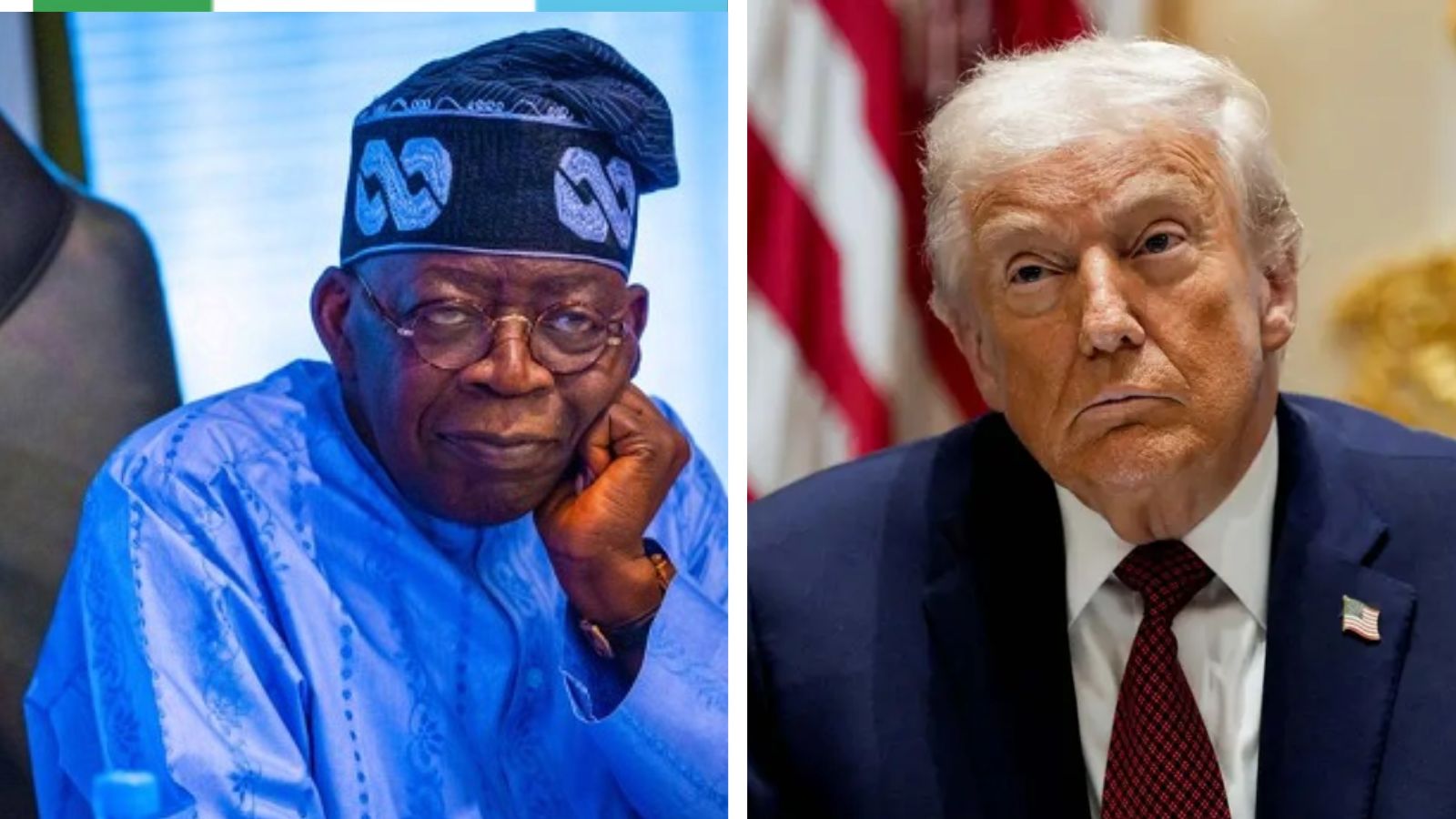
President Donald Trump has announced a sweeping expansion of US travel restrictions, imposing new visa limitations on Nigeria and 14 other countries, as part of what the White House describes as a renewed effort to strengthen border security and protect national interests.
According to a report obtained by New Daily Prime, Trump on Tuesday signed a proclamation extending and tightening entry restrictions on nationals from countries deemed to have persistent deficiencies in screening, vetting and information-sharing with the United States. The move marks a significant escalation of travel controls reminiscent of policies introduced during Trump’s first term in office.
Under the new proclamation, Nigeria has been placed under partial restrictions, alongside Angola, Antigua and Barbuda, Benin, Côte d’Ivoire, Dominica, Gabon, The Gambia, Malawi, Mauritania, Senegal, Tanzania, Tonga, Zambia and Zimbabwe. The restrictions apply to both immigrant and non-immigrant visa categories, particularly business, tourist, student and exchange visitor visas.
Read more from the New Daily Prime:
Trump bars visas for 10 African Nations, others after shooting of two guards
Trump to impose visa ban on persons linked to alleged Christians genocide in Nigeria
In justifying Nigeria’s inclusion, the US administration cited security concerns linked to the presence of extremist groups, as well as visa overstay rates. The proclamation states that radical Islamist organisations such as Boko Haram and Islamic State affiliates continue to operate in parts of Nigeria, creating challenges for effective screening and vetting. US authorities also referenced Department of Homeland Security overstay data, which showed a B-1/B-2 visa overstay rate of 5.56 per cent for Nigerian nationals and an overstay rate of 11.90 per cent for student, vocational and exchange visitor visas.
The White House said the restrictions were necessary to address national security and public safety risks, arguing that inadequate civil documentation systems, weak law-enforcement data sharing and high overstay rates undermine the integrity of US immigration controls.
The proclamation maintains full entry suspensions for nationals of 12 countries previously designated as high risk, including Afghanistan, Iran, Libya, Somalia, Sudan, Yemen and Haiti, while adding five new countries — Burkina Faso, Mali, Niger, South Sudan and Syria — to the list of nations subject to full restrictions.
Individuals travelling on Palestinian Authority-issued travel documents have also been barred, with US officials citing security risks arising from the ongoing conflict in Gaza and the West Bank, and what they described as compromised vetting capabilities in those territories.
In addition, the proclamation escalates restrictions on Laos and Sierra Leone, which had previously faced partial limitations, placing both under full suspension due to high visa overstay rates and long-standing refusals to accept back nationals ordered removed from the United States.
While the measures are broad, the administration said exemptions would apply to lawful permanent residents, existing visa holders, diplomats, athletes and individuals whose entry serves US national interests. Case-by-case waivers will also remain available, though the proclamation narrows family-based visa carve-outs that US officials argue are vulnerable to fraud.
Announcing the decision, the White House said the president was acting within his constitutional authority to prevent the entry of individuals who cannot be adequately vetted. The statement added that many of the affected countries suffer from widespread corruption, unreliable civil registries and weak birth-registration systems, making it difficult for US agencies to verify identities and assess risks.
Officials also pointed to the refusal by some governments to share passport samples or law-enforcement data, as well as the operation of citizenship-by-investment schemes that allow individuals to obtain travel documents without meaningful residency requirements.
Trump’s latest move revives a central pillar of his first-term immigration agenda. During his earlier presidency, he imposed travel bans on several countries, policies that were challenged in court but ultimately upheld by the US Supreme Court. In its ruling, the court held that the restrictions fell within the scope of presidential authority and were based on legitimate national security objectives.
The White House said the new proclamation builds on updated intelligence assessments and country-specific reviews conducted under recent executive orders, arguing that the restrictions are tailored to encourage cooperation from affected governments while recognising differing national circumstances.
For Nigeria, the decision is likely to have diplomatic and practical implications, particularly for students, business travellers and families with ties to the United States. Nigerian officials have yet to issue a formal response, though past US travel restrictions affecting African countries have drawn criticism from regional leaders and civil society groups, who argue that such policies risk unfairly stigmatising entire populations.
Supporters of the measures, however, say the restrictions are necessary to restore integrity to the US immigration system and reduce security vulnerabilities. “It is the president’s duty to ensure that those seeking to enter the United States will not harm the American people,” the White House said.
The proclamation comes as Trump seeks to reinforce his “America Safe Again” agenda, with immigration expected to remain a central issue in US domestic politics. Whether the expanded restrictions will prompt legal challenges or diplomatic pushback remains to be seen.
For more details, visit New Daily Prime at www.newdailyprime.news.