
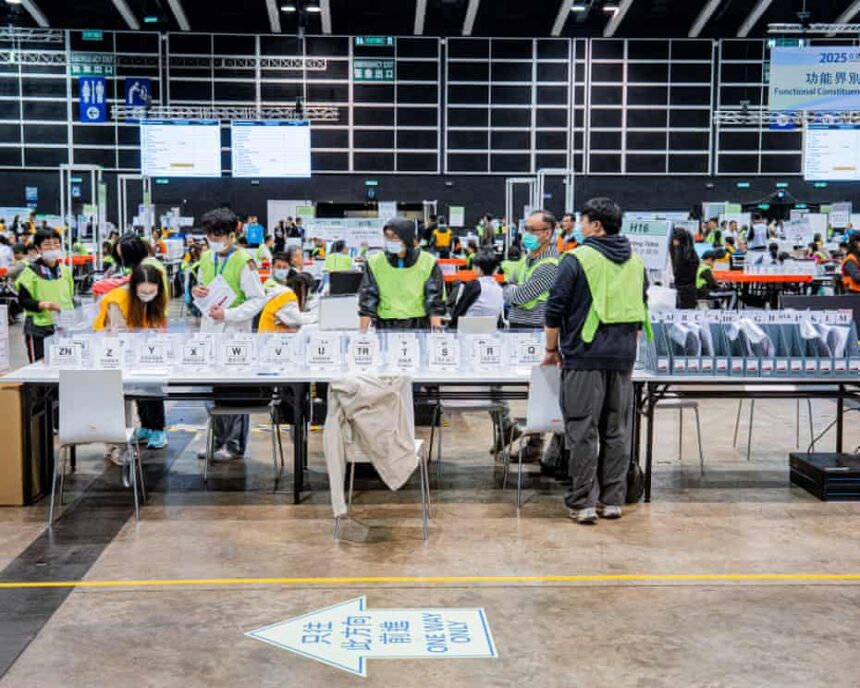


Hong Kong recorded one of its lowest ever voter turnouts in Sunday’s Legislative Council elections, with fewer than 32% of eligible voters casting their ballots. The figure of 31.9% was only marginally higher than the record low of 30.2% in 2021, though the overall number of voters fell to 1.3 million compared with 1.4 million four years ago. The city’s population is about 7.5 million.
The elections were held under the “patriots only” system introduced after an overhaul in 2021, which restricts candidacy to those vetted by a government committee. Of the 90 seats in the legislature, only 20 are directly elected. The government mounted an extensive campaign to encourage turnout, extending polling hours by two hours, distributing “thank you cards” redeemable for rewards in local businesses, and releasing an election anthem entitled Let’s Vote, Together We Create the Future, inspired by Cantopop star Aaron Kwok’s 2001 hit Strong.
Since the electoral changes, boycotting the vote has become one of the few ways for Hongkongers to express dissatisfaction. Inciting others to boycott was criminalised in 2021.
On Sunday, the Independent Commission Against Corruption announced the arrest of four men aged between 31 and 44 for allegedly encouraging others not to vote or to cast invalid ballots online. In total, 11 people have been arrested in relation to such offences during the current election, with three prosecutions already underway.
The election took place against the backdrop of Hong Kong’s worst tragedy in decades: the Tai Po fire, which killed at least 159 people after engulfing seven apartment blocks in a residential compound in the city’s north. Allegations of building safety violations and questions over enforcement have prompted demands for transparency and accountability from the government.
Mourning activities and calls for responsibility have drawn suspicion from authorities, who have launched a sweeping crackdown under Beijing’s national security regime. At least three people have been arrested for alleged national security offences, including student Miles Kwan, who initiated an online petition, former district councillor Kenneth Cheung, and 71‑year‑old commentator Wong On‑yin.
On Saturday, officials cleared an impromptu memorial site near the burned buildings where residents had laid flowers. The clearance, announced in advance, began late at night. “I wish it could go for longer as I believe there are still people who did not have enough time or the chance to express their feelings,” one resident told Reuters.
Earlier that day, Steve Li, chief superintendent of the police’s national security department, said he had observed “familiar” scenes at Tai Po reminiscent of the 2019 protests, citing pamphlets and signs “basically unrelated to the disaster”. He claimed the situation was becoming “more and more like that of ‘black‑clad violence’”.
Authorities have also targeted foreign media over their coverage of the fire, summoning representatives of outlets including the New York Times on Saturday. Some Hongkongers who had been posting information online or contributing to civilian resources have since stopped, citing concerns their activity could be “misconstrued”.
At Hong Kong Baptist University last week, a student‑made “democracy wall” calling for justice for victims was covered up, and the following day, the student union was shut down.
The combination of low voter turnout, the aftermath of the Tai Po fire, and the government’s crackdown has underscored the tense political climate in Hong Kong, where expressions of dissent remain tightly controlled under Beijing’s national security framework.