
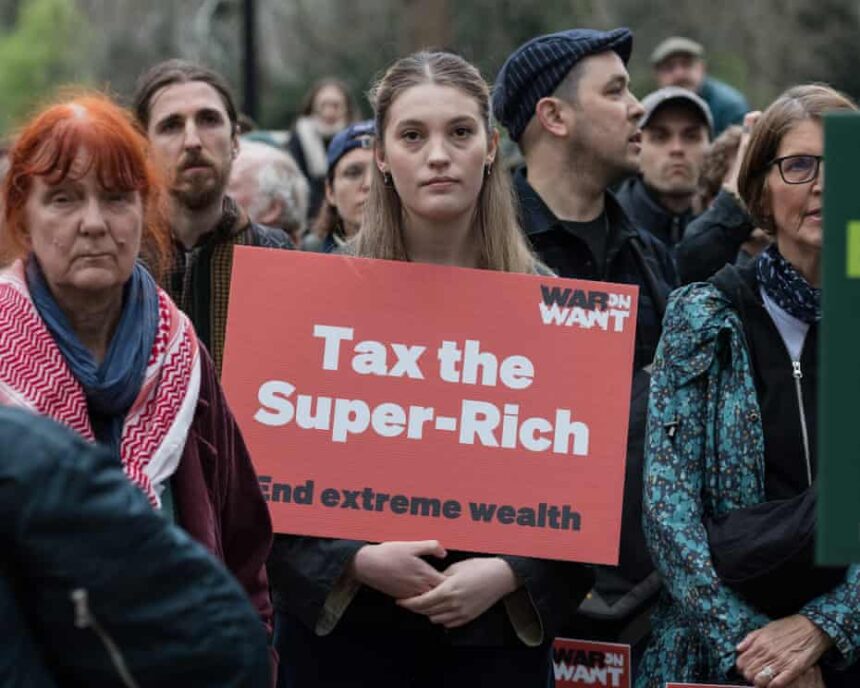
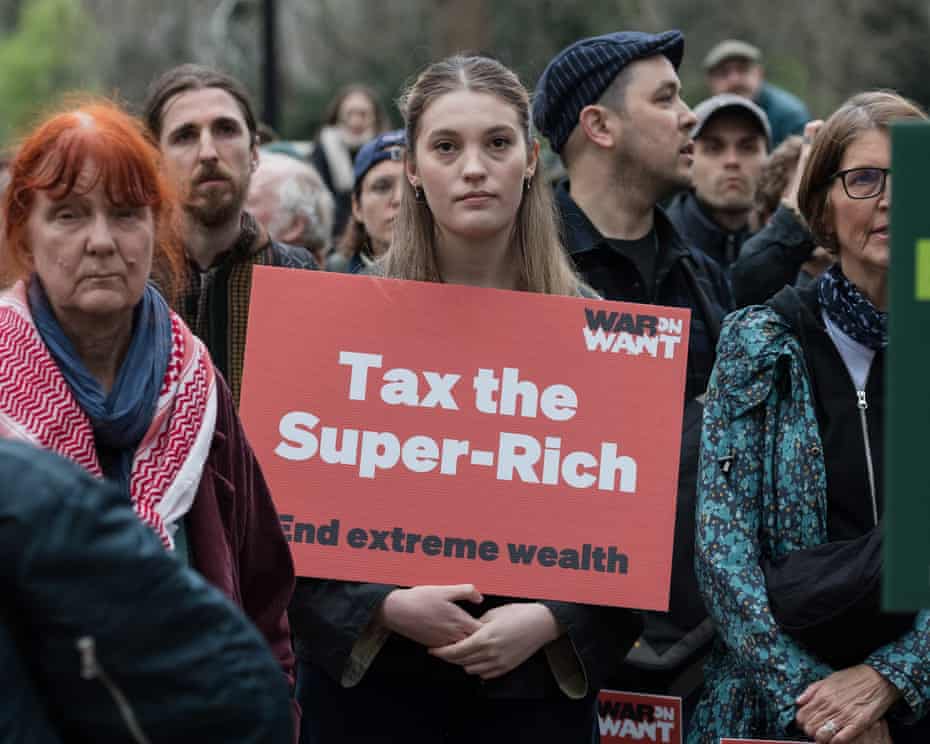
Fewer than 60,000 people, just 0.001% of the world’s population, now control three times as much wealth as the entire bottom half of humanity, according to a major study that warns inequality has reached extremes requiring urgent action.
The World Inequality Report 2026, compiled by 200 researchers, found that the richest 10% of income-earners take home more than the other 90% combined, while the poorest half capture less than 10% of global earnings.
Wealth, defined as the value of assets, was even more concentrated than income. The richest 10% own 75% of global wealth, while the bottom half hold just 2%. In almost every region, the top 1% were found to be wealthier than the bottom 90% combined.
“The result is a world in which a tiny minority commands unprecedented financial power, while billions remain excluded from even basic economic stability,” the authors, led by Ricardo Gómez-Carrera of the Paris School of Economics, wrote.
The share of global wealth held by the top 0.001% has risen from nearly 4% in 1995 to more than 6% today. The wealth of multimillionaires has grown by about 8% annually since the 1990s, almost double the rate of the bottom half of the population.
French economist Thomas Piketty, one of the report’s authors, said inequality had “long been a defining feature of the global economy” but by 2025 had “reached levels that demand urgent attention”. Reducing inequality, he argued, was essential not only for fairness but for the resilience of economies, the stability of democracies and the viability of the planet.
Produced every four years with the United Nations Development Programme, the report draws on the world’s largest open-access database on economic inequality and is considered highly influential in shaping international debate.
In a preface, Nobel prize-winning economist Joseph Stiglitz repeated his call for an international panel similar to the UN’s IPCC on climate change, to monitor inequality worldwide and provide evidence-based recommendations.
The report highlighted stark disparities in opportunity. Education spending per child in Europe and North America is more than 40 times that in sub-Saharan Africa – a gap three times greater than GDP per capita. A 3% global tax on fewer than 100,000 centimillionaires and billionaires could raise $750bn annually, equivalent to the education budgets of low and middle-income countries.
It also criticised a global financial system “rigged in favour of rich countries”, with advanced economies borrowing cheaply and investing abroad at higher returns. Around 1% of global GDP flows from poorer to richer nations each year through net income transfers, nearly three times the amount of development aid.
On gender inequality, the report found women earn on average 61% of men’s hourly pay when unpaid work is excluded. Including unpaid labour, the figure falls to just 32%.
The study also linked wealth concentration to climate change. The poorest half of the world’s population account for only 3% of carbon emissions associated with private capital ownership, while the wealthiest 10% are responsible for 77%. Those who emit the least are also the most vulnerable to climate shocks, it said.
The authors stressed that inequality can be reduced through public investment in education and health, alongside effective taxation and redistribution. Yet in many countries, the ultra-rich escape taxation. “Effective income tax rates climb steadily for most of the population, but then fall sharply for billionaires and centimillionaires,” the report noted.
It concluded that reducing inequality is ultimately a political choice, hindered by fragmented electorates, under-representation of workers and the outsized influence of wealth. “The tools exist. The challenge is political will,” it said.