
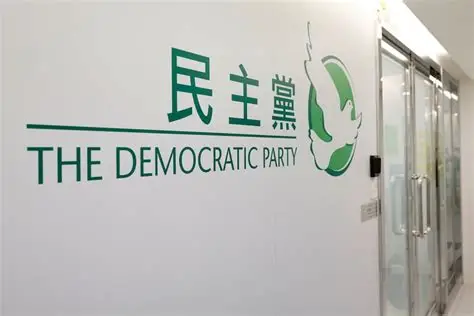
Hong Kong’s last major opposition party has voted to disband, marking the end of an era for the city’s pro-democracy movement. The Democratic Party (DP), long regarded as the main liberal force in Hong Kong politics, announced its dissolution after an extraordinary general meeting on Sunday.
The decision follows years of mounting pressure from Beijing, which has tightened its grip on the territory through sweeping national security laws and electoral reforms.
Founded in 1994, three years before Hong Kong’s return to Chinese rule, the Democratic Party was once a dominant force in city-wide legislative elections. It consistently pushed for democratic reforms and sought to hold Beijing to its promise of maintaining freedoms under the “one country, two systems” arrangement.
That promise has steadily eroded. The mass protests of 2019, which drew millions onto the streets against perceived encroachments by China, prompted Beijing to impose a far-reaching national security law in 2020. The legislation criminalised dissent and led to the arrest of scores of activists, journalists, and politicians.
On Sunday, party chair Lo Kin-hei confirmed that members had voted overwhelmingly to disband. Of 121 ballots cast, 117 supported dissolution, with four abstentions.
“To have journeyed through these three decades, shoulder to shoulder with the people of Hong Kong, has been our greatest honour,” Lo told reporters. “Throughout these years, we have always treated the wellbeing of Hong Kong and its people as our guiding purpose.”
Senior figures within the party had previously revealed that they were approached by Chinese officials or intermediaries and warned to disband or face severe consequences, including possible arrest.
The Hong Kong Liaison Office, Beijing’s main representative body in the city, did not immediately respond to requests for comment.
Emily Lau, a former chair of the Democratic Party, expressed sorrow at the outcome. “Why does an organisation that has done so much for Hong Kong need to end like this? I find it very problematic,” she said.
Lau added that Hong Kong had never been able to achieve genuine democracy. “We never had the chance to elect our government. We hope the principle of one country, two systems won’t keep shrinking more and more. We hope there won’t be more and more people being arrested.”
The vote to disband came just a week after Hong Kong held a legislative council election restricted to “patriots only” candidates. It also coincided with the impending verdict in the national security trial of media mogul and outspoken China critic Jimmy Lai.
China’s overhaul of Hong Kong’s electoral system in 2021 effectively sidelined the Democratic Party by ensuring that only candidates vetted as “patriots” could stand for public office. This reform removed the party from mainstream politics and left it with little room to manoeuvre.
The Democratic Party is not the first pro-democracy group to fold under pressure. In June, the League of Social Democrats announced its own dissolution, citing “immense political pressure.”
Several senior Democratic Party members, including Wu Chi-wai, Albert Ho, Helena Wong and Lam Cheuk-ting, have been jailed or held in custody under the national security law. Their detention further weakened the party’s ability to function.
The crackdown has drawn criticism from Western governments. Both the United States and the United Kingdom have condemned the national security law, arguing that it has been used to silence dissent and curtail individual freedoms.
China, however, insists that no freedom is absolute. Officials maintain that the law has restored stability to Hong Kong after the turmoil of 2019.
The disbanding of the Democratic Party underscores the shrinking space for political opposition in Hong Kong. Once a vibrant hub of debate and activism, the city has seen its civil society dismantled, media outlets closed, and opposition voices silenced.
For many residents, the end of the Democratic Party represents not only the loss of a political organisation but also the fading of hopes for democratic reform.
As Lau reflected, “We were never able to have democracy. We never had the chance to elect our government.”
The dissolution of Hong Kong’s last major opposition party leaves the city’s political landscape firmly under Beijing’s control, with little prospect of change in the foreseeable future.