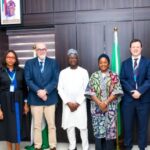

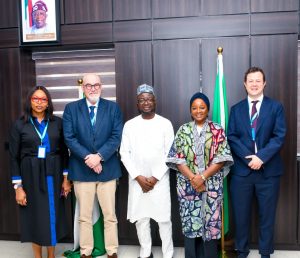
Nigeria’s Minister of Humanitarian Affairs and Poverty Reduction, Dr. Bernard M. Doro, has held a high-level technical session with a delegation from the United Nations Office for the Coordination of Humanitarian Affairs (UNOCHA).
The meeting, led by UNOCHA’s Head of Office, Mr. Trond Jensen, took place on Wednesday at the Minister’s Conference Room in Abuja, during which officials reviewed the country’s Humanitarian Needs and Response Plan (HNRP) and assessed the implications of significant funding cuts by major international donors.
According to a report made available to New Daily Prime, Dr. Doro praised the UN agency’s “longstanding partnership” and expressed concern that shrinking global resources were forcing countries like Nigeria to strengthen domestic systems. He noted that post-COVID realities and shifting global priorities had placed unprecedented strain on international institutions and developing nations, underscoring the need for stronger local systems and coordinated national responses.
“What matters is that our national and sub-national systems are coordinated, responsive, and capable of meeting the needs of our people. Early interventions must begin closest to the affected communities,” the Minister said.
Dr. Doro disclosed that the Federal Government will inaugurate a National Council on Humanitarian Affairs and Poverty Reduction in January 2026, designed to unify federal ministries, state governments, NGOs, and development partners under a single coordinated platform.
He also announced the Ministry’s effort to establish a National Humanitarian Dashboard — Project One Poverty Reduction System — to ensure visibility, coordination, and harmonization of all humanitarian and development activities across ministries, agencies, development partners, and civil society organizations.
“Nigeria must know what everyone is doing in the humanitarian and development space,” he added.
“This will allow us to design better policies and implement them with greater efficiency and accountability.”
UNOCHA Warns of “Critical” Funding Shortfalls
In a candid assessment, Mr. Jensen outlined the structural pressures constraining global humanitarian operations. He revealed that Nigeria had historically relied heavily on the United States for nearly 60% of its humanitarian funding, but that support has now significantly declined. The United Kingdom, Germany, and several other major donors have also announced reductions.
“Solidarity is in short supply globally,” he said.
“As funding shrinks, we must focus strictly on life-saving interventions. Next year, humanitarian assistance will target 2.5 million people, down from more than six million previously.”
UNOCHA is urging a shift toward increased use of local partners, cash-based aid, and reduced administrative layers that diminish the resources reaching vulnerable communities.
Jensen also highlighted the organisation’s long-term transition strategy:
“By 2028, international humanitarian operations in Nigeria will not be present at current levels. It is essential that we work with the Government to build systems that are locally led, locally implemented, and locally financed.”
He raised concerns about bureaucratic delays in clearing medical and nutritional supplies at Nigerian ports and appealed for ministerial support in facilitating dialogue with NAFDAC and the Ministry of Health.
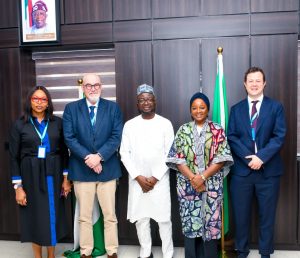
Both sides reaffirmed their commitment to developing a transition framework that strengthens Nigerian institutions while safeguarding life-saving support for millions who remain in need. The session was attended by UN officials including Mr. Peter Rice, representatives from UNOCHA’s Humanitarian Response and Information units, and senior directors from Nigeria’s Nutrition and Poverty Reduction Departments.